
November 9, 2019

Dental X-rays: Why, Which, & When?

Author

Dr. Charles Payet

Update First Last in Content -> Business Text -> First Last field

Date

November 9, 2019

Share

Digital dental x-rays have come a long way in improving our ability to diagnose problems in your teeth and jaws. But which ones do you need, when do you need them, and why do dentists recommend each kind?

Types of Dental X-rays

Periapical X-rays

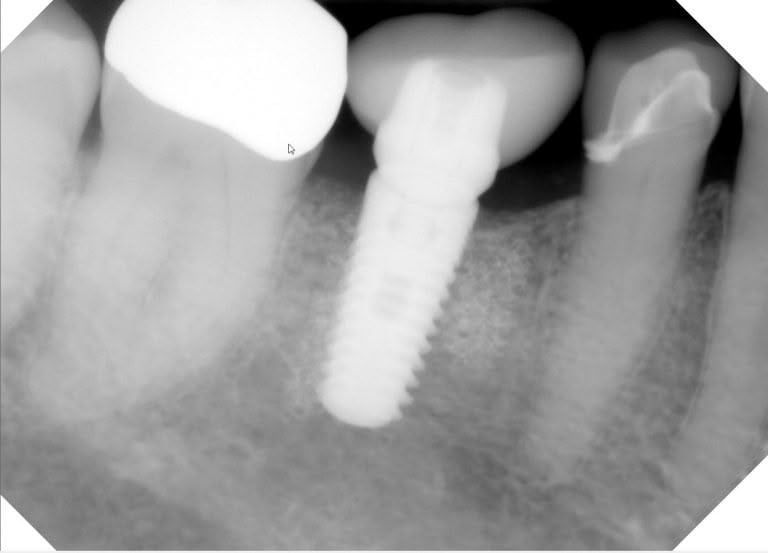
Dental X-ray showing a tooth implant with a crown, and adjacent teeth with fillings.

Periapical x-rays capture the full length of 1 or more teeth, so that we can see the apex, or end, of the root.  That’s where we look for signs of a tooth abscess, or infection. We also use them, as in this case, to make sure that dental implants are fully integrated in the bone.

Bitewing X-rays

These  x-rays of the back teeth are usually taken in groups of 2 or 4, so 1 or 2 per side. Sometimes it may be a group of 7 in a different orientation.  Most people have get them every 12 months to check for cavities between the teeth, where we can’t see them.  If you’ve never had a cavity between your teeth and are at low risk, your dentist might change it to every 18-, 24-, or rarely every 36 months.  Or if you get cavities a lot, your dentist might even recommend them every 6 months. The patient in the below example has gotten a mouthful of dental crowns in her 70+ years. Because we want to catch any cavities around the crowns early, she definitely gets bitewings once a year.

4 bitewing x-rays showing dental crowns, fillings, and a dental implant

Full-Mouth Series

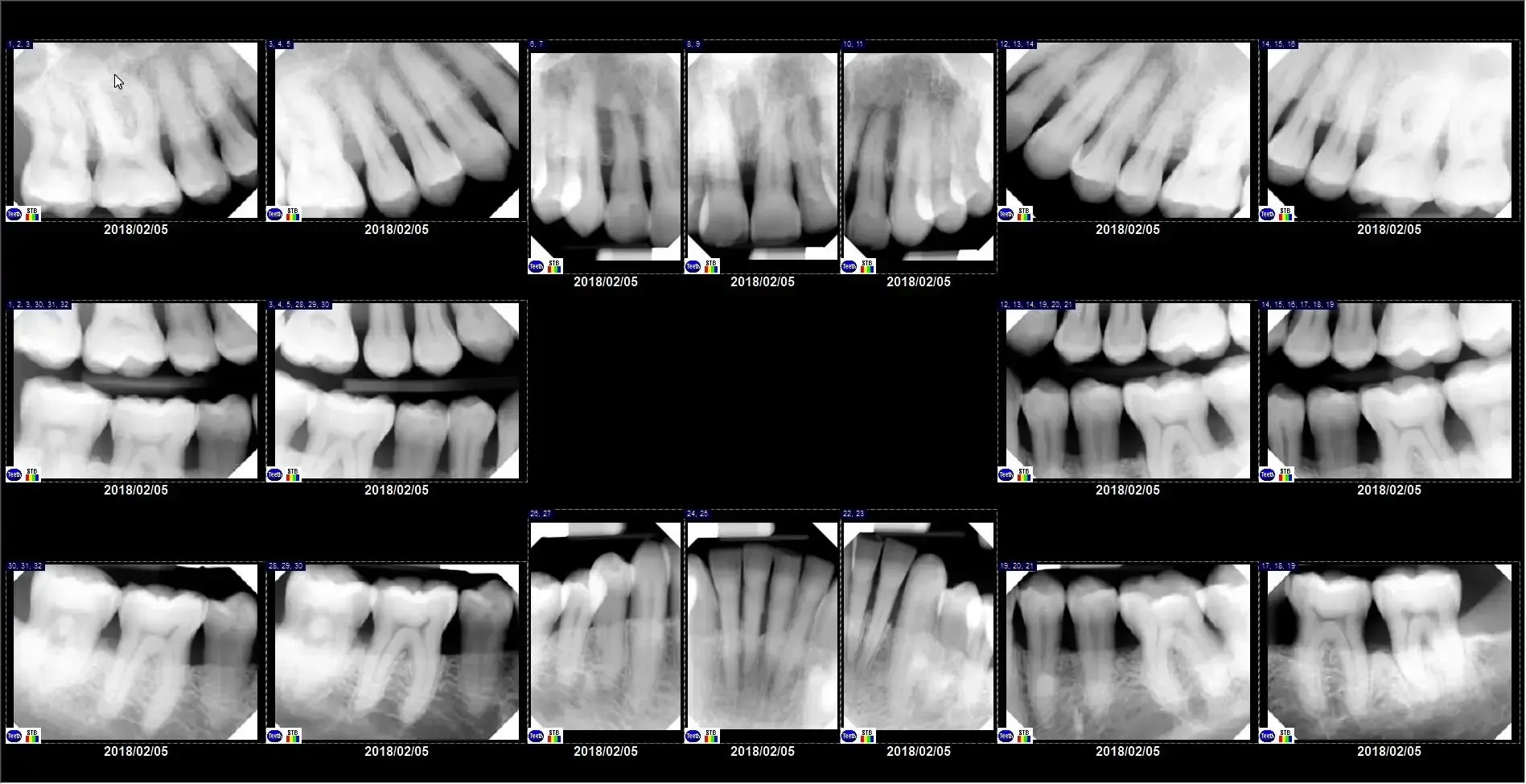
For patients who have cavities on many teeth, or especially if they have gum (periodontal) disease , we take a full-mouth series of x-rays.  This is a minimum of 10 total x-rays, including both bitewings and periapical dental x-rays.

Dental X-ray images, showing various teeth, in a panoramic view.

Panoramic Dental X-rays

The dental x-rays you see below are called panoramic x-rays.  This kind is usually taken ever 3-5 years to screen for possible bone cysts, tumors, sinus abnormalities, etc.  It’s also used to check growth and development in children, to make sure their teeth are developing normally.  The first one shown here, which I labeled, is of a healthy patient.

panoramic x-ray of a healthy patient
A panoramic x-ray, with labels showing anatomy of teeth and jaws

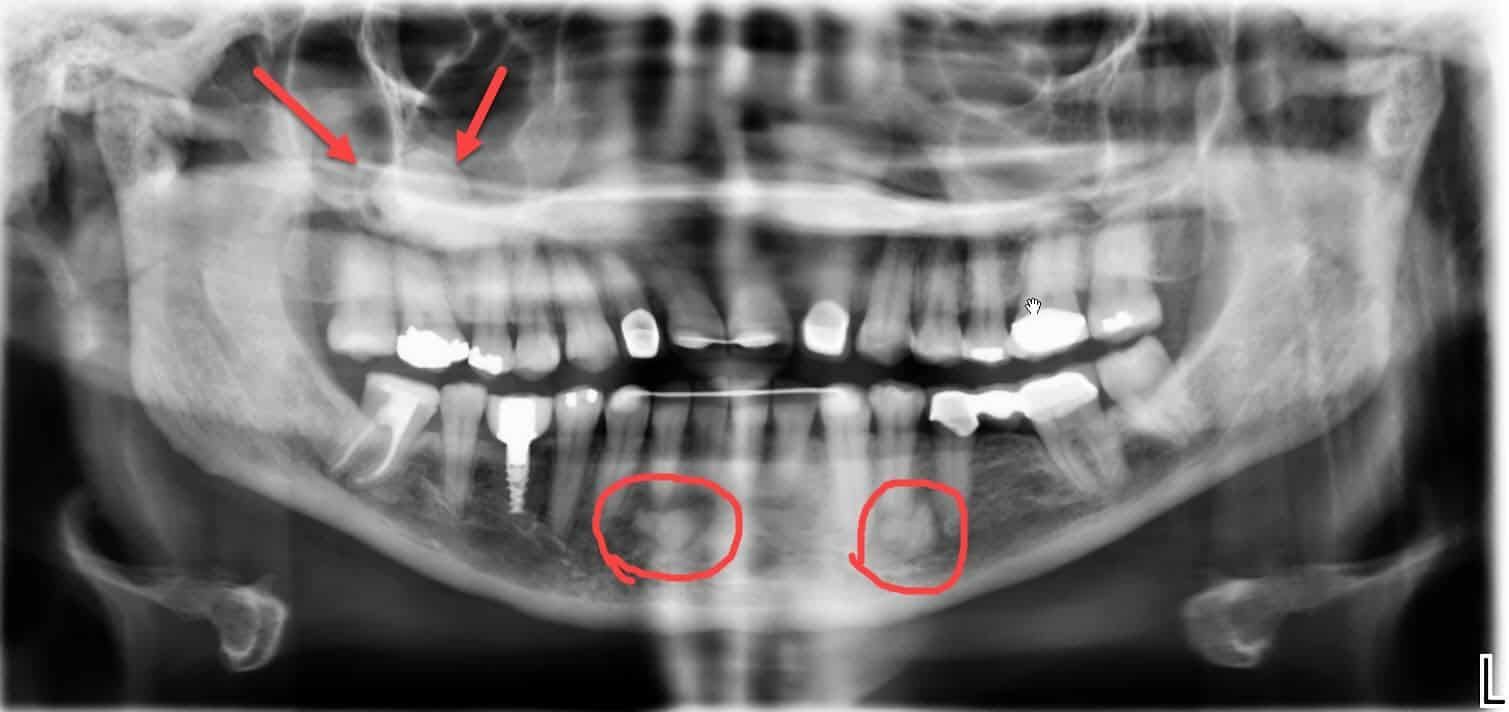
But this panoramic x-ray, taken in the fall of 2019, surprised me with several unusual areas.  There’s a large, dense, circular something in the right sinus, which definitely doesn’t belong there.  There are also 2 irregular areas of unusually dense bone on the lower jaw.  We have sent this patient to an oral surgeon for further evaluation.

panoramic x-ray showing pathology
A panoramic x-ray showing several areas of concern,

Because we wanted more information about those unusual areas, we took another kind of dental x-ray, described next.

Cone Beam X-ray, or CT Scan

When we need a lot more detail, or different perspectives and angles, we take a CT scan, also called a cone beam or 3D x-ray.  Cone beam images are quite different from the other types, because they’re taken in slices.  Computer algorithms turn those slices into a 3D images.  That 3D x-ray can be rotated in every direction, and we can scan through it up/down, forward/back, and side-to-side.  They’re really quite incredible!

These cone beam views are of the same patient above, with the panoramic x-ray.  Now we see the true size and shape of those unusual areas.

cone beam CT scan views
Different views of the jaw with a cone beam x-ray, or CT scan.

3D X-Rays for Dental Implants

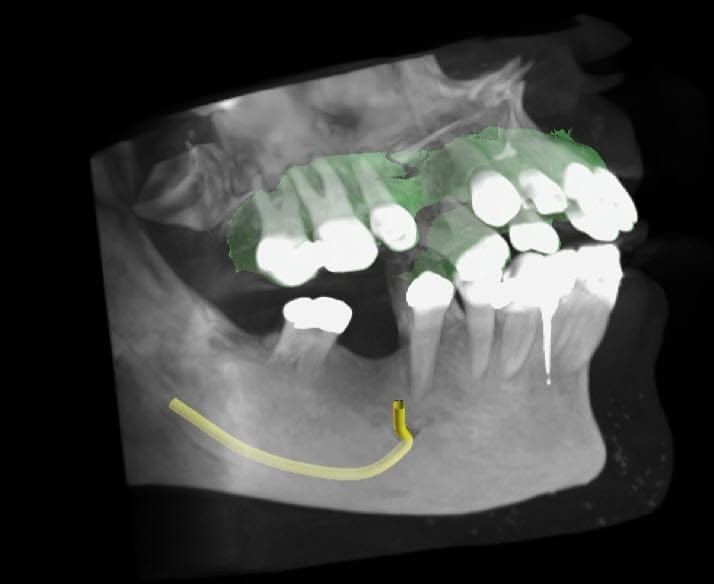
Dental x-ray scan of teeth, with some highlighted in green, and a yellow, tube-like structure in the jaw.

When planning dental implants , we have to know if the bone is both wide and tall enough.  If it is, great!  If not, then you may need a bone graft or sinus lift to build up the bone.  Without the 3D views, we can’t know that.  We can also see other important anatomy, like the big nerve in your lower jaw (the yellow line).   We really don’t want to run into that!

In short, dental x-rays give us critical information about both your teeth and your jaws.  Without them, it’s really impossible for us to do a good job for you.

Call 704-364-7069 or Contact us for a Comprehensive or Emergency Exam. 

It’s that easy to start.

By Dr. Charles Payet July 19, 2024
How long does a professional teeth whitening last?,Ever thought about if your bright, shiny smile from a professional teeth whitening will last? Many people get dental bleaching to make their smiles better. But, they wonder how long these results will last. Will your teeth stay white for a year, or maybe even longer? Key Takeaways Introduction to Professional Teeth Whitening Professional teeth […]Smiles By Payet | Charlotte Dentist Dr. Chip Payet, DDS
By Dr. Charles Payet June 10, 2024
How much do veneers cost in Charlotte NC?,Have you ever dreamed of having a smile as bright as those in Hollywood? If you’re looking into dental veneers in Charlotte, NC, you might be surprised by the price differences. These differences come from several factors. For example, at Smiles by Payet Dentistry, you could pay up to $2500 for each veneer. The cost […]Smiles By Payet | Charlotte Dentist Dr. Chip Payet, DDS
By Dr. Charles Payet May 16, 2024
Cost of Full Mouth Dental Implants: A Comprehensive Guide,Did you know that the total cost for full mouth dental implants can range anywhere from $17,000 to a staggering $90,000 in 2023? This surprising figure underscores the significant investment required for dental implants, which are often seen as a more permanent and comfortable alternative to dentures and dental bridges. Understanding the cost of full […]Smiles By Payet | Charlotte Dentist Dr. Chip Payet, DDS
By Dr. Charles Payet August 11, 2019
What is Root Resorption? Can it Be Fixed?,Root Resorption comes in 2 flavors, so to speak: Internal and External.  It’s one of the least common reasons for losing a tooth, compared to tooth decay and gum disease.  When it is found though, it usually means the tooth is doomed.  But what is root resorption? Internal & External Root Resorption FAQs The term […]Smiles By Payet | Charlotte Dentist Dr. Chip Payet, DDS
By Dr. Charles Payet March 23, 2019
Repairing a Broken Dental Bridge,If you have a dental bridge and some of the porcelain has broken off in a place visible in your smile, the bridge usually has to be replaced.  Sometimes however, the bridge can be repaired with a creative and nifty technique called an “overcrown.”  This isn’t always an option, but when it is, it’s a […]Smiles By Payet | Charlotte Dentist Dr. Chip Payet, DDS
By Dr. Charles Payet August 9, 2016
Why Can’t Dentists Cure Cavities or Regrow Enamel?,I’ve previously discussed why you can’t cure cavities, but recent research sounds promising, so it’s a good time to review.  In addition, there were some good points raised in the comments of the previous article that deserve more attention.  Be warned: lots of bullet lists ahead as I break it down.  ðŸ˜€ Recap: Why We Currently Can’t Grow Dentin […]Smiles By Payet | Charlotte Dentist Dr. Chip Payet, DDS
By Dr. Charles Payet April 30, 2016
Replacing Veneers after 15 Years,There are a number of important questions to ask when considering cosmetic dentistry, including porcelain veneers: Recently, we saw a patient for whom I did 8 porcelain veneers in 2001, and his case illustrates all of these questions, so without further ado, let me introduce Steve’s teeth.  (He’s a rather private person and prefers not having […]Smiles By Payet | Charlotte Dentist Dr. Chip Payet, DDS
By Dr. Charles Payet April 25, 2016
Dental Cavities: How Fast Can They Grow?,How fast dental cavities grow may sound like a simple question, but it’s actually rather complicated.  I decided to write about it, though, after seeing a patient recently to treat a cavity that went from just beginning to an almost-root-canal-sized cavity in just 14 months.  It’s a good example of why most dentists still recommend dental […]Smiles By Payet | Charlotte Dentist Dr. Chip Payet, DDS
By Dr. Charles Payet April 4, 2016
We Do NOT Discriminate,Let me start off by saying that, while I’m not a native North Carolinian, I have lived here for almost 26 years and have deep family roots in the state, as my Mom was born in Lewisville and grew up in Albemarle (most of our extended family still live in the state, too), and my […]Smiles By Payet | Charlotte Dentist Dr. Chip Payet, DDS
By Dr. Charles Payet July 23, 2015
You’re unhappy with your smile and are thinking about getting some cosmetic dentistry done, but you’re not sure how many teeth to have done? In this article I’ll answer many of the most Frequently Asked Questions (FAQs) that we hear during Cosmetic Dentistry Consultations. If you’d like to see more examples of the cosmetic dentistry that we do in our Charlotte dental office, you can read and see more here: Cosmetic Dentistry Before-and-After Porcelain Veneers Before-and-After Porcelain Bridges
Show More